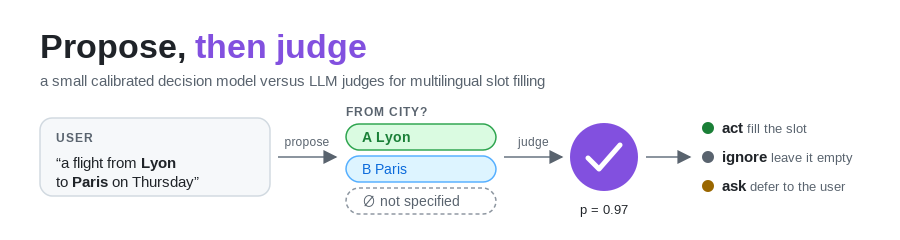
laya-slotjudge-m46 fills the slots of a task-oriented dialogue — city, date, dish, contact… — by choosing among values proposed by cheap extractors, or by answering not specified. Its probability is calibrated, so your assistant can act, ignore or ask the user. With about 0.3 B parameters, it is more accurate than LLM judges of 27 to 180 B parameters.
Large language models are often used to arbitrate between options. They choose well when the right value is there — but they rarely say “nothing was said”. In a dialogue, most slots of a schema are not mentioned in a given turn, and every wrong fill becomes a wrong action.
Test-set results of the paper (MultiATIS++, MTOP and Multi3WOZ, English and French; monolingual models, same recipe as laya-slotjudge-m46). LLM judges: Qwen3.8-27B, Gemma-4-31B-it, Qwen3.8-Flash-Next (27–180 B parameters).
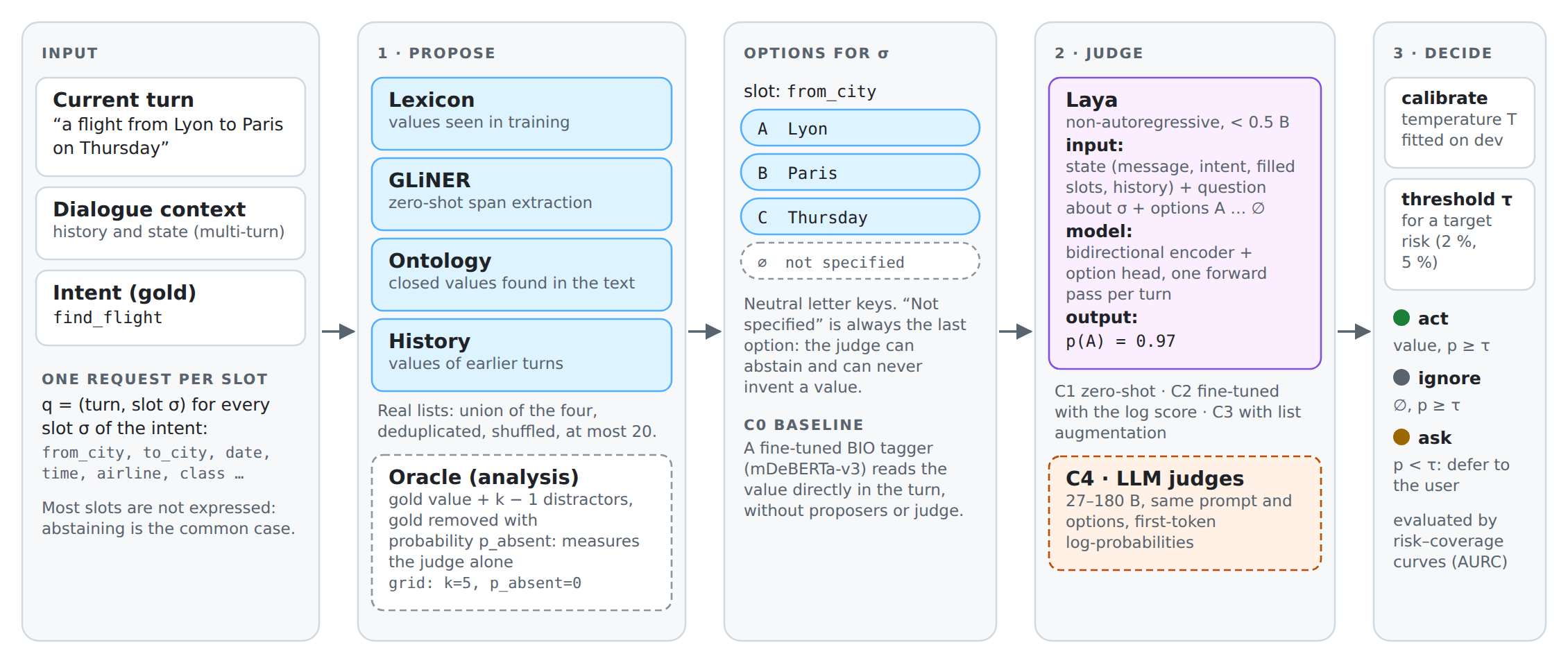
Generation and decision are separated. Proposers are cheap and generous; the judge is small, fast and honest about its doubts.
Move the sliders in the interactive guide →
Lexicons, a multilingual NER model, the ontology, earlier turns — or an LLM — suggest candidate values for each slot.
For every slot, one multiple-choice question: the candidates, plus “not specified”. One forward pass scores all the slots of the turn.
A temperature calibrates the probability; a threshold set for a target risk turns it into act, ignore or ask.
The questions are always written in English; the dialogue can be in any of the 46 languages.

Slot F1 on the test sets, run once after every decision had been taken on development data; means over 3 seeds (5 for C3). Laya: best of the fine-tuned variants; LLM: best of three judges.
| Dataset | Lang. | Laya, oracle lists | LLM, oracle lists | BIO tagger | Laya, real lists | LLM, real lists |
|---|---|---|---|---|---|---|
| MultiATIS++ | EN | 0.941 | 0.427 | 0.949 | 0.829 | 0.531 |
| MultiATIS++ | FR | 0.925 | 0.383 | 0.923 | 0.832 | 0.556 |
| MTOP | EN | 0.953 | 0.753 | 0.904 | 0.695 | 0.583 |
| MTOP | FR | 0.951 | 0.753 | 0.833 | 0.629 | 0.529 |
| Multi3WOZ | EN | 0.946 | 0.844 | 0.733 | 0.853 | 0.762 |
| Multi3WOZ | FR | 0.919 | 0.753 | 0.380 | 0.592 | 0.474 |
paired comparisons of slot F1 and false-positive rate between the fine-tuned judge and the three LLMs, all in its favour (Holm-corrected permutation tests).
Random option lists help on synthetic tests but hurt on real candidates; adding values of the other slots of the utterance as distractors gives robustness at no cost.
A BIO tagger wins when values are literal spans (MultiATIS++, MTOP); the pipeline wins on dialogue (Multi3WOZ), where many gold values are not in the turn.
The recipe of the paper, trained once on four public datasets in many languages, with a development set that contains both oracle and real candidate lists.
| Dataset | Languages | Licence |
|---|---|---|
| MTOP | en de es fr hi th | CC BY-SA 4.0 |
| Multi3WOZ | en fr ar tr | MIT |
| MASSIVE 1.1 | 47 locales | CC BY 4.0 |
| Schema-Guided Dialogue | en | CC BY-SA 4.0 |
Single-turn assistant commands in 46 languages; multi-turn dialogue in English, French, Arabic and Turkish. MultiATIS++ is not used (LDC licence).
Held out to measure generalisation:
Install the Laya runtime, download the weights, ask one question per slot. Keep the instruction templates and the “not specified” option exactly as below (in English), and shuffle the candidates.
# pip install "laya>=0.3,<0.4" huggingface_hub from huggingface_hub import snapshot_download from laya import Router path = snapshot_download("ChristopheCruz/laya-slotjudge-m46", revision="v1.0") router = Router(models={"multilingual": path}) state = {"last_user_message": "weck mich morgen um sieben Uhr", "intent": "set_alarm"} options = ["morgen", "sieben Uhr"] criteria = {chr(65 + i): v for i, v in enumerate(options)} criteria[chr(65 + len(options))] = "not specified: the last message gives no value for this slot" question = { "type": "choice", "instructions": 'Which value does the user\'s last message give for the slot "time" (time of the alarm)?', "criteria": criteria, } [result] = router.predict_batch([{"state": state, "questions": {"time": question}, "model": "multilingual"}]) print(result["answers"]["time"]["probabilities"]) # {'A': 0.0042, 'B': 0.9834, 'C': 0.0124}
The LayaJudge class of the code repository builds the questions, shuffles the options, groups all the slots of a turn into one call, and implements calibration and the three-zone decision.
Any frequent, well-defined decision among proposed options, where a wrong action costs more than a question.
Booking, customer service, support, appointment scheduling — in dozens of languages.
Pick the right value among those found in e-mails, tickets or reports, or flag that it is missing.
Choose a tool argument and know when to act alone and when to ask for confirmation.
Arbitrate between options at a fraction of the cost and latency, with honest probabilities.
Pass the generated value and its alternatives as candidates; accept, reject or ask.
Under 2 GiB of GPU memory, shareable with the other components of the system.
Propose, then judge: a small calibrated decision model versus large language model judges for multilingual slot filling. Christophe Cruz, Hussam Ghanem, Hocine Cherifi. Preprint, HAL hal-05850913, 2026.
@unpublished{cruz2026proposejudge,
author = {Cruz, Christophe and Ghanem, Hussam and Cherifi, Hocine},
title = {Propose, then judge: a small calibrated decision model versus large language model
judges for multilingual slot filling},
year = {2026},
note = {Preprint},
url = {https://hal.science/hal-05850913},
hal_id = {hal-05850913},
hal_version = {v1}
}
Please also cite Laya and the training datasets (MTOP, Multi3WOZ, MASSIVE, SGD).