OntoVersionGraph
Research and goals
This project was the subject of Perrine Pittet's PhD.
Ontology: a little history
Originally, ontology is a fundamental branch of metaphysics, a philosophical discipline. Like many philosophical concepts, the foundations of ontology were laid by the Greeks centuries before Christ.
"Ontology: Ontos (being) + Logos (study)"
This concept was then studied, used and developed by great names in history such as Plato, Thomas Aquinas, Descartes and Kant.
Ontologies in computer science
In computer science, one of the authoritative definitions in the scientific literature is that of Gruber, in 1993.
Definition "An ontology is an explicit specification of a conceptualization" Gruber The "domain" is the world that the ontology must describe. This description is a vocabulary of concepts shared by all specialists in the domain, hence the notion of "shared conceptualisation". Finally, for a machine to understand it, this description must be specified in an expressive, unambiguous, that is "explicit", language.
Several characteristics have refined this definition in the literature.
Characteristics
- Ontologies are formal: they are expressed in a defined language and syntax, based on mathematics for their definitions. This allows computers to process these concepts.
- Ontologies are readable by humans and computers. They are developed and shared by humans to be used by machines.
- Ontologies are broad. They are meant to include all the knowledge associated with the concepts of the domain studied, and should not be limited to the scope of a particular application.
- Ontologies are shareable. Given their final goal, publication on the internet to form a gigantic database, ontologies are like large libraries. This makes it easier to merge ontologies and insert them into information systems.
Ontology evolution
Change in the air The world we know is subject to the inevitable law of time and undergoes its changes. Time is a factor of change, and a changing world means changing knowledge of it. Logically, if ontologies describe this world, they must integrate its changes. Ontologies are not only affected by changes coming from their domain. Here is a way of examining the causes of these changes, based on Gruber's definition.
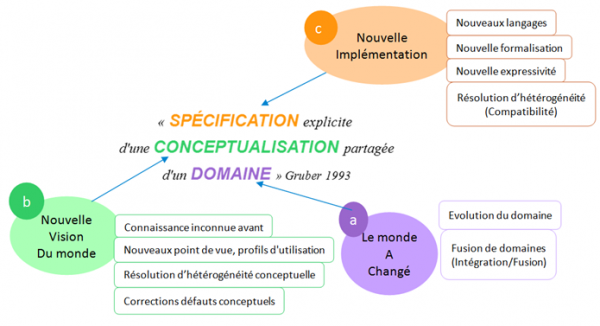
Changes can also occur at the conceptualisation level of the ontology. The domain, or our knowledge of it, can imply changes to concepts. For example, a 1990s mobile phone has no notion of touch screen or camera, which are concepts attributed to today's mobiles. Likewise, the concept of smartphone did not exist then. The conceptualisation of the ontology can also be affected by a new point of view on the domain, such as a new perspective of use. In a city, a bridge will be seen as a way of crossing a river by a driver, but as an obstacle by a boat. Finally, the specification of the ontology may have to change, especially when the language used is not expressive enough. For example, a disjunction of concepts can only be represented with a language that provides this notion. This makes it possible, for instance, to ensure that an individual cannot be both a woman and a man in the ontology.
The research field related to these issues is called ontology evolution. It is all the more crucial because ontologies are used by applications that depend on them, or by other ontologies. A change to an ontology affects all the components that depend on it, sometimes making concepts inaccessible. There is also a notion of consistency in ontologies whose specification is based on logic: a change can introduce contradictions within the ontology. An inconsistent ontology can no longer be used to infer new knowledge or guarantee the consistent operation of the application using it. Managing consistency during evolution is one of the most critical points. Finally, the evolution of an ontology generates new versions, and to guarantee access to a given version, the ontology needs a versioning system. The related research field is called ontology versioning. Combined with evolution, versioning gives transparent access to the different versions of the ontology. It also keeps the history of all changes made to each version, which allows comparisons or other checks after the evolution.
Publications
Article dans une revue
- Perrine Pittet, Christophe Cruz, Christophe Nicolle. An ontology change management approach for facility management. Computers in Industry, Elsevier, 2014, Special Issue on The Role of Ontologies in Future Web-based Industrial Enterprises, 65 (9), pp.1301-1315. 10.1016/j.compind.2014.07.006.
Chapitre d'ouvrage
- Perrine Pittet, Christophe Cruz, Christophe Nicolle. Ontology Views for Ontology Change Management. IGI Global. Encyclopedia of Information Science and Technology, Third Edition, Information Science Reference (an imprint of IGI Global), pp.5180-5187, 2015, Encyclopedia of Information Science and Technology, Third Edition, 978-1-4666-5888-2. 10.4018/978-1-4666-5888-2.ch512.
Communication dans un congrès
- Christophe Cruz, Perrine Pittet. A Meta-Conceptual Modeling Approach for Change Modeling in Applied Ontology, 15th International Conference on Informatics in Economy (IE 2016), Education, Research & Business Technologies, Jun 2016, Cluj Napoca, Romania, IE 2016: EDUCATION, RESEARCH & BUSINESS TECHNOLOGIES, pp.442-447, 2016, International Conference on Informatics in Economy.
- Perrine Pittet, Christophe Cruz, Christophe Nicolle. Modeling Changes for SHOIN(D) Ontologies: An Exhaustive Structural Model. ICSC 2013, Seventh IEEE International Conference on Semantic Computing, Sep 2013, Irvine, United States. pp.Perrine Pittet, 2013.
- Perrine Pittet, Christophe Cruz, Christophe Nicolle. A Structural SHOIN(D) Ontology Model for Change Modelling. 2nd International Workshop on Methods, Evaluation, Tools and Applications for the Creation and Consumption of Structured Data for the e-Society (META4eS'13), Sep 2013, Graz, Austria. Springer Berlin Heidelberg, 8186, pp 442-446, 2013, 10.1007/978-3-642-41033-8_56.
- Mahdi Gueffaz, Perrine Pittet, Sylvain Rampacek, Christophe Cruz, Christophe Nicolle. INCONSISTENCY IDENTIFICATION IN DYNAMIC ONTOLOGIES BASED ON MODEL CHECKING. The 8th International Conference on Web Information Systems and Technologies, Apr 2012, Porto, Portugal. pp.418-421, 2012.
- Perrine Pittet, Christophe Nicolle, Christophe Cruz. Guidelines for a Dynamic Ontology - Integrating Tools of Evolution and Versioning in Ontology. KMIS 2011 - International Conference on Knowledge Management and Information Sharing is part of 3rd International Joint Conference on Knowledge Discovery, Knowledge Engineering and Knowledge Management., Oct 2011, Paris, France. 2011.
- Perrine Pittet, Christophe Cruz, Christophe Nicolle. Towards Dynamic Ontology - Integrating Tools of Evolution and Versionning in Ontology. IARIA. SEMAPRO 2010, The Fourth International Conference on Advances in Semantic Processing, Oct 2010, Florence, Italy. pp.978-1-61208-104-5, 2010.