Research
My research lies at the intersection of knowledge modelling, generative AI and agentic systems. The central goal is to design intelligent architectures able to reason, adapt and interact with humans in a natural, context-aware way.
Generative AI and large language models
The emergence of large language models (LLMs) has profoundly transformed natural language processing. I am particularly interested in their use in demanding business settings: extractive and abstractive summarisation, multi-label classification, Dynamic Topic Modeling, and economic and strategic intelligence.
This work was carried out with the company Actualis until 2022. It continues with the TIL Laboratory at the University of Burgundy, notably on semantic frames and on formalising idiomaticity as lexico-grammatical patterns.
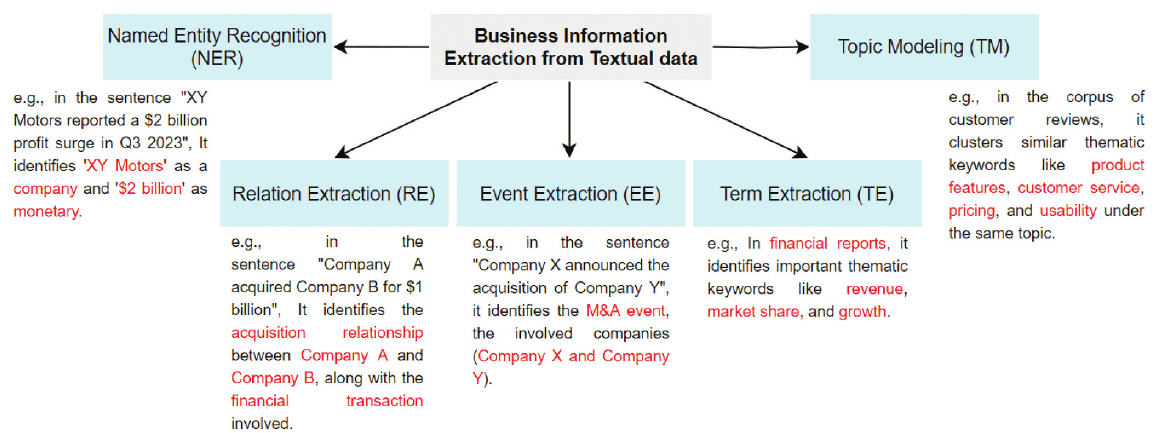
Business information extraction tasks from text. Source: Arslan, Munawar, Cruz, Journal of Decision Systems, 2024, CC BY 4.0 licence.
Related publications
- Arslan, Munawar, Riaz, Cruz. Large language models for business and management applications: A review. Information Processing & Management, 2026. Link
- Arslan, Munawar, Cruz. Business insights using RAG–LLMs: a review and case study. Journal of Decision Systems, 2024. Link
- Arslan, Cruz. Business text classification with imbalanced data and moderately large label spaces for digital transformation. Applied Network Science, 2024. Link
Hybrid neuro-symbolic AI
Given the known limitations of LLMs (hallucinations, incompleteness, lack of traceability), I develop hybrid neuro-symbolic approaches that combine knowledge graphs and generative models. These architectures extract structured knowledge from text and return a reliable, explainable representation of it.
This work began with the DL4Graphs project with the company DAVI (France Relance funding) and was extended by a European OCRE Google Cloud project (€250k of cloud credit, 2022) using infrastructure such as Vertex AI, Neo4J and Kubernetes.
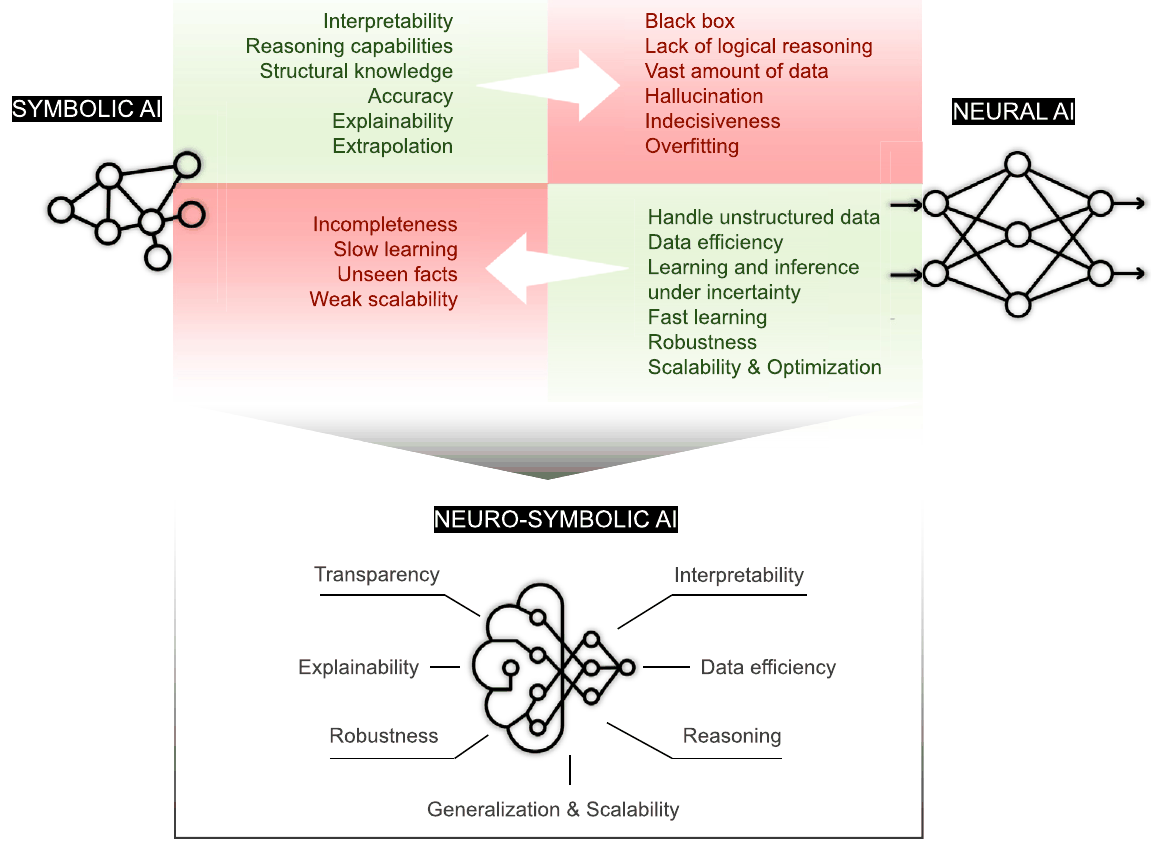
Neuro-symbolic AI combines the strengths of symbolic and neural AI. Source: Bougzime et al., Materials & Design, 2025, CC BY 4.0 licence.
Propose, then judge (2026). In a conversational assistant, inexpensive extractors propose candidate values, and a small calibrated decision model picks one of them or abstains, then acts, ignores or asks the user. This judge, with fewer than half a billion parameters, is more accurate than LLMs with 27 to 180 billion parameters. The multilingual model laya-slotjudge-m46 (46 languages) is open. Project website · HAL preprint · Code · Model
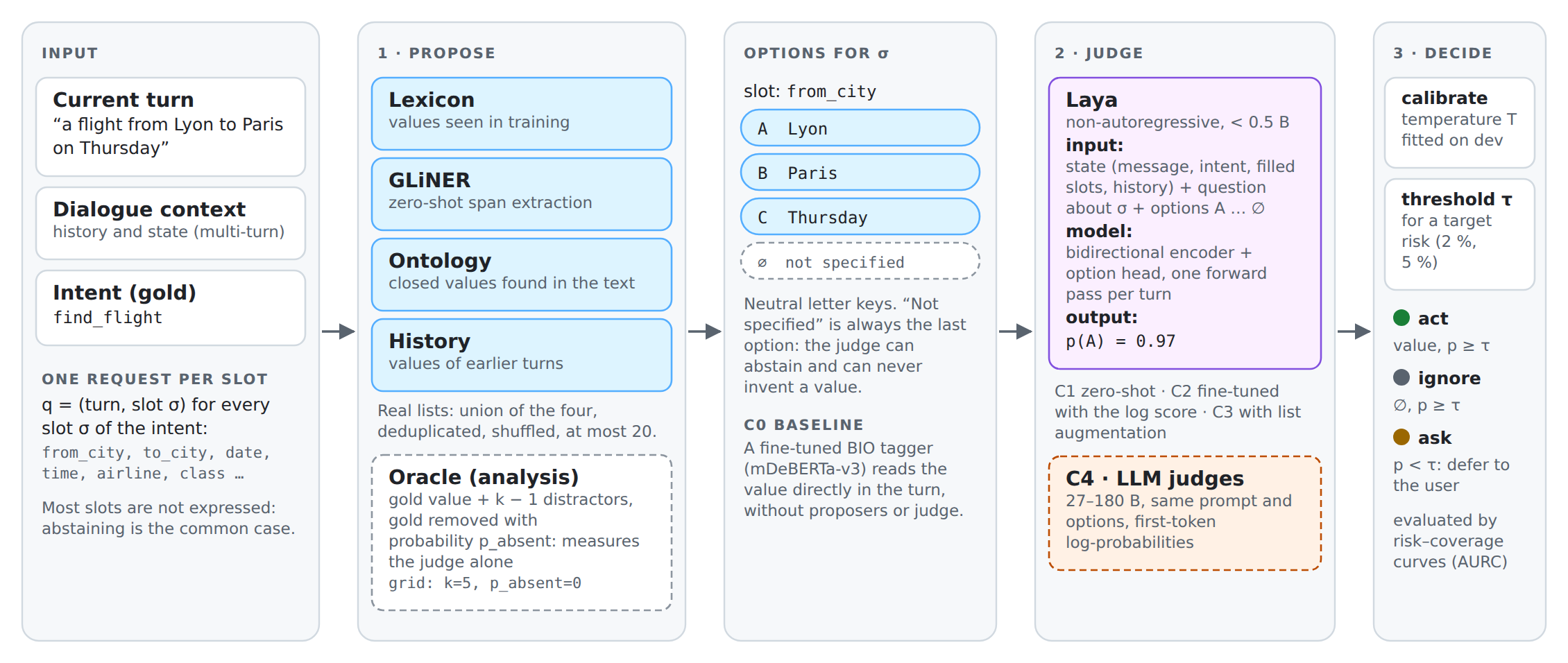
The propose-then-judge architecture, illustrated on one request. Source: Cruz, Ghanem, Cherifi, HAL preprint, 2026, CC BY 4.0 licence.
Related publications
- Bougzime, Jabbar, Cruz, Demoly. Neuro-Symbolic Architectures: Formalizing, Extending, Evaluating, and Empowering Generative Artificial Intelligence. Neurosymbolic Artificial Intelligence, 2026. Link
- Bougzime, Cruz, André, Zhou, Qi, Demoly. Neuro-symbolic artificial intelligence in accelerated design for 4D printing: Status, challenges, and perspectives. Materials & Design, 2025. Link
- Cruz, Ghanem, Cherifi. Propose, then judge: a small calibrated decision model versus large language model judges for multilingual slot filling. HAL preprint, 2026. Link
RAG and knowledge graphs
RAG (Retrieval-Augmented Generation) is today one of the most promising paradigms for grounding LLMs in reliable, evolving knowledge bases. My approach uses knowledge graphs to structure, enrich and validate the knowledge base available to the model, which allows more precise navigation, better extraction of implicit relations and more relevant answers.
This work is explored in particular in Oualid Bougzime's PhD on knowledge management for smart materials and 4D printing.
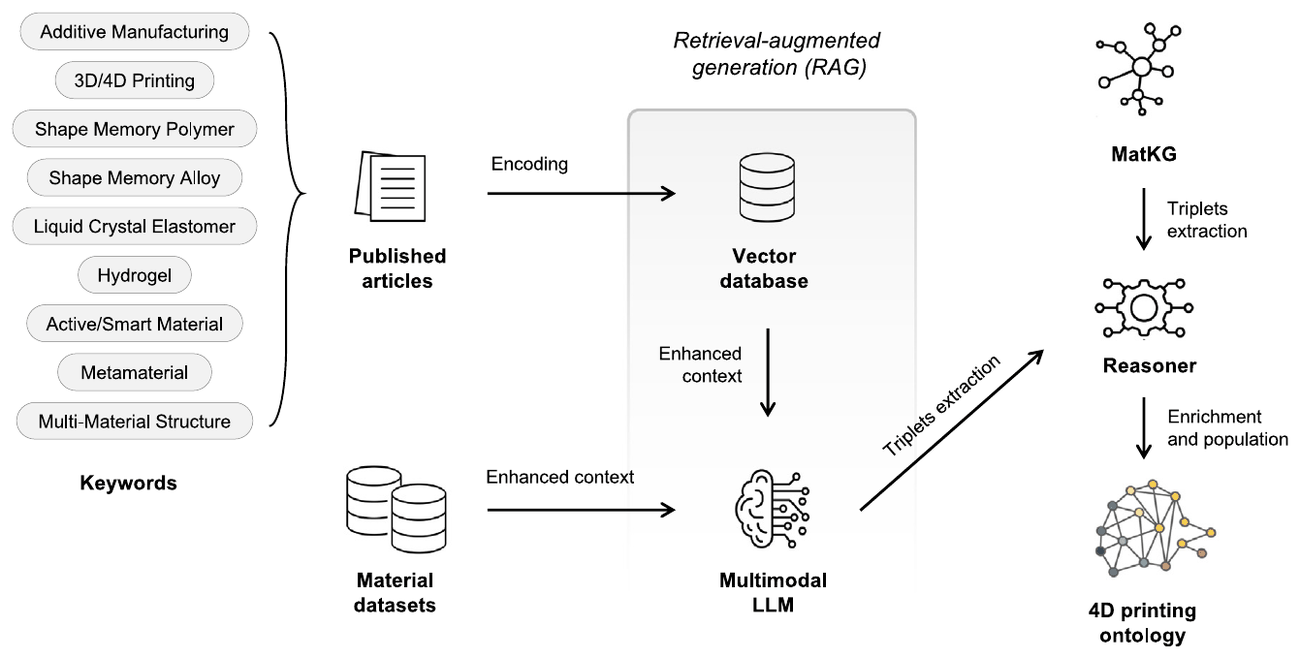
Retrieval-augmented ontology construction pipeline for 4D printing. Source: Bougzime et al., Computers in Industry, 2026, CC BY 4.0 licence.
Related publications
- Bougzime, Cruz, Zhou, Qi, Demoly. Structuring scientific knowledge for smart materials and 4D printing: An ontology enrichment framework using retrieval-augmented multimodal large language models. Computers in Industry, 2026. Link
- Ghanem, Cruz. Fine-tuning or prompting on LLMs: evaluating knowledge graph construction task. Frontiers in Big Data, 2025. Link
- Arslan, Munawar, Cruz. Political-RAG: using generative AI to extract political information from media content. Journal of Information Technology & Politics, 2024. Link
AI agents and human-machine interaction
My most recent research focuses on agentic AI: systems able to perceive their environment, reason, plan and act autonomously to achieve complex goals.
This work takes place mainly within the LabCom LAMAE (ANR-24-LCV1-0008-01), a joint laboratory with the company DAVI The Humanizers, dedicated to developing multimodal, empathetic and adaptive agents. The ambition is to design agents that do not merely answer, but perceive, understand and adapt to each user, based on a 4M architecture:
| Dimension | Description |
|---|---|
| Multi-Agents | Expert, emotional and contextual agents collaborating in a network |
| Multi-Graph-RAG | Distributed memory and structured knowledge storage |
| Multi-Modality | Processing of text, image, sound and video |
| Multi-Profile | Dynamic adaptation to user profiles and needs |
Two recent results illustrate this topic. LAMAE-Mem (ISCS 2026) proposes a three-tier memory architecture (working, episodic and long-term) for LLM agents that take emotions into account. A study presented at AGENTICS 2026 analyses how hallucinations propagate between agents across five multi-agent architectures. It received the Best Paper Award.
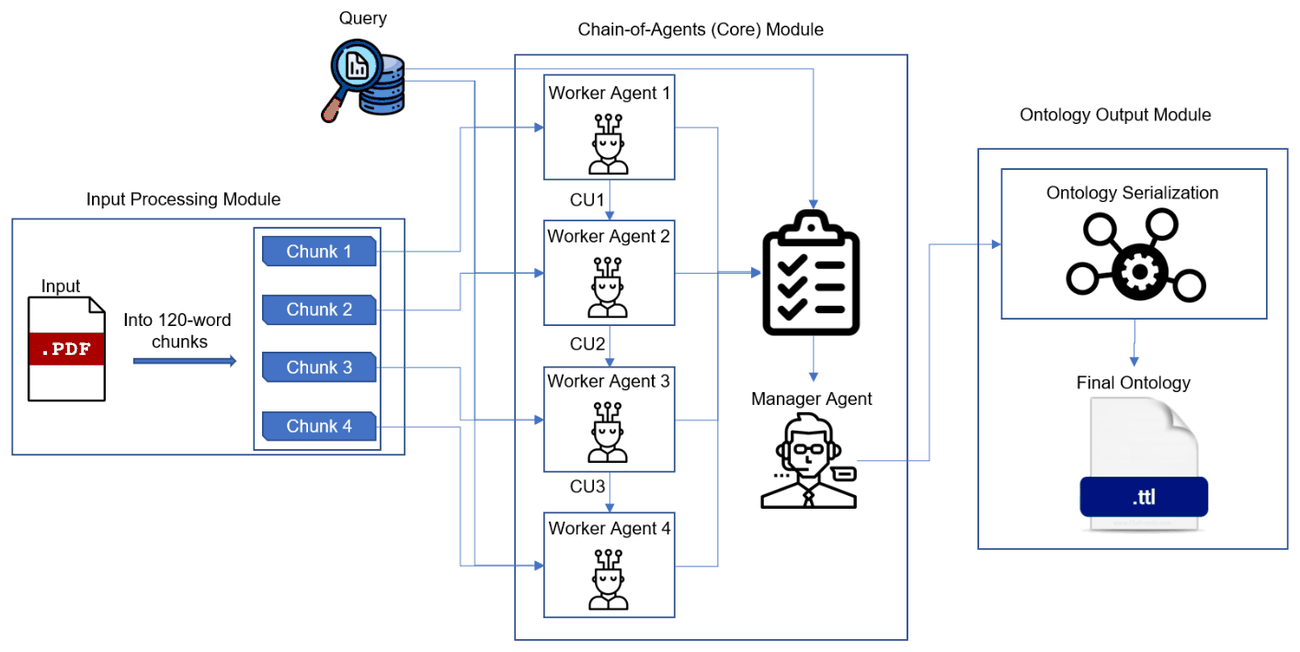
CoA-Text2OWL framework: a chain of agents builds an ontology from text. Source: Jabbar, Cruz, report, 2025.
Related publications
- Jabbar, Bougzime, Cruz, Bertolim. DocAgent-XAI: An Entropy-Guided Agentic RAG System for Adaptive and Explainable Clinical History-Taking. AIiH 2026. Link
- Ghanem, Jabbar, Cruz. CoA-Text2OWL: Enhancing Ontology Learning with Chain-of-Agents Framework. Procedia Computer Science, 2025. Link
- Ghanem, Cruz, Cherifi. Toward Human-Aligned, Modular, and Emotion-Aware Multi-Agent Systems: A Systematic Literature Review. Preprint, 2026. Link
Cognitive Network Science for human-AI systems
Cognitive Network Science applies graph theory and complexity science to model human cognitive structures, such as semantic memory or emotional associations. I use it to understand and improve interactions between humans and AI.
A systematic review, presented at KES 2026 and following the PRISMA 2020 method, identifies five themes: theoretical foundations, auditing AI and LLM systems, human-AI collective intelligence, social and emotional AI, and education, creativity and cognitive augmentation.
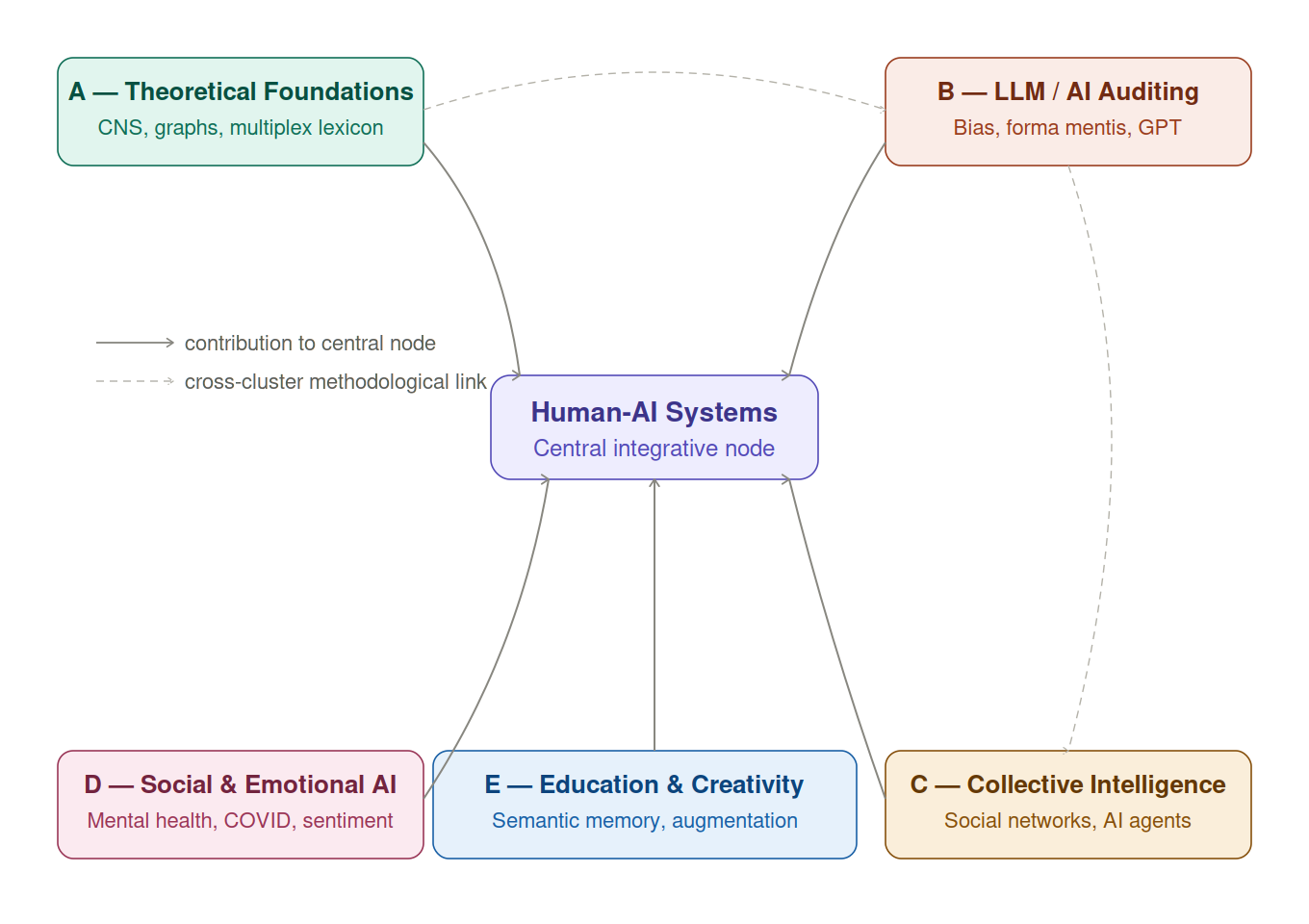
The five themes of the systematic review. Source: review GitHub repository, CC BY 4.0 licence.
A second line of work focuses on cognitive load and metacognition in human-AI conversations. It proposes a formal framework that estimates both directly from transcripts, without sensors. Conversations are represented as a multiplex temporal network whose layers capture semantic, syntactic, emotional and cognitive dimensions. Latent cognitive states are inferred with a Hidden Markov model. This framework opens the way to adaptive educational chatbots and conversational systems aware of the user's cognitive state.
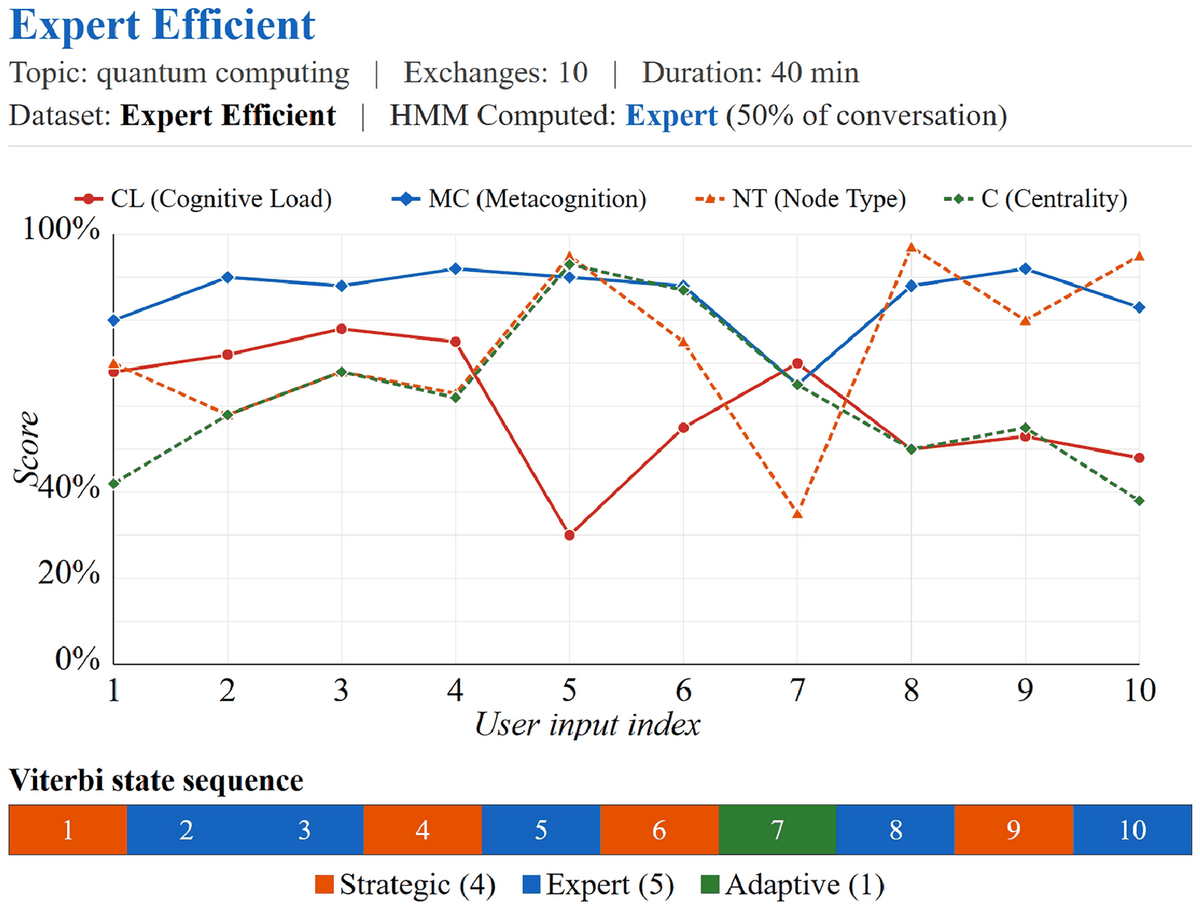
Evolution of cognitive load, metacognition, node type and centrality over a conversation, with the inferred state sequence. Source: Cruz et al., Social Network Analysis and Mining, 2026, figure 3, CC BY 4.0 licence.
Related publications
- Cruz, Jabbar, Ghanem, Bertolim, Cherifi. Temporal network analysis of cognitive load and meta-cognition dynamics in human-AI conversations. Social Network Analysis and Mining, 2026. Link
- Cruz, Ghanem, Jabbar, Bertolim, Cherifi. Temporal Network Analysis of Cognitive-Metacognitive Dynamics in Human-AI Conversations. Complex Networks & Their Applications XIV, 2026. Link
- Cruz, Ghanem, Jabbar, Theroine, Gautier, Bertolim, Cherifi. Cognitive Network Science for Human-AI Systems: A Systematic Review. KES 2026, Procedia Computer Science, to appear. Repository