S-HMC Maintenance
This work was the subject of Rafael Peixoto's PhD.
Context
Data production is growing exponentially, lending weight to the Big Data phenomenon. The term Big Data refers to very large datasets characterised by several dimensions (Volume, Velocity, Variety). These data or data streams fall outside the traditional framework of standard processing approaches. This is why extracting knowledge and its value is complex for both industry and consumers seeking to reduce information overload.
Although traditional data analysis methods in data mining seem suited to processing massive data (e.g. hierarchical multi-label classification), they fail to identify data semantics, resulting in abstruse understanding and reduced value. Ontologies are a solution for systems operating close to human levels of conceptualisation, and are one of the most accepted ways of describing and capturing semantics in the Semantic Web research community and among companies using these technologies.
Combining these technologies with big data processing technologies is the key to the proposed approach for improving value extraction in Big Data, thus reducing the gap between user perspectives and analysis methods (e.g. classification models). The goals of this work are twofold. First, it proposes a new classification method for the hierarchical multi-classification of articles based on a rule-enriched ontology and "Web Reasoning" methods. Second, it proposes an approach to maintain and evolve the classification system in the context of Big Data and non-stationary data streams.
The research scope
Big Data analysis can be deemed as the analysis technique for a special kind of data. The analysis of Big Data is the final and most important phase in the value chain of Big Data, with the purpose of extracting values that provide suggestions or decisions [Chen et al., 2014]. Therefore, many traditional data analysis methods such as Data Mining Algorithms (Classification, clustering, regression, among others) may still be utilized for Big Data Analysis [Chen et al., 2014]. The aim is to study the maintainability of a classification process that classifies data items according to an ontology-described classification model using a web reasoner in the context of Big Data. Therefore three main research areas define the scope of this research.
- Big Data: The term of Big Data is mainly used to describe enormous datasets characterized by an increasing number of V’s (Volume, Velocity, Variety, Veracity, Value). Such amount of data requires new forms of processing to enable enhanced decision-making, insight discovery and process optimization. This thesis focuses on automatically classified data items in the context of Big Data.
- Classification: Classification is a machine-learning method used to predict different classes according to some constrains and to create a model to classify newly available data. In recent years, many approaches have been proposed to further improve classification performance by incorporating label correlations or exploiting label hierarchy. Among all existing types of classification, this thesis focuses on a specific type of classification that exploits connections in label hierarchy called Hierarchical Multi-Label Classification (HMC).
- Ontologies: Ontologies allow the definition of terms and meanings used to represent areas of knowledge. Ontologies are a good solution for intelligent compsystems that operate close to a human concept level bridging the gap between human requirements and the computational requirements [Obrst, 2003]. From an ontology scope, this thesis aims to use ontologies to describe the classification model, ontology evolution to evolve the classification model according to data streams, and web reasoning to classify the items.
Since scalability is important in Big Data context, simple but highly scalable techniques are used in order to improve it compared to traditional classification approaches. The used techniques must allow the parallelization of the process and distribute it across several loosely coupled machines. The number of labels in many domains keeps growing during this, and even simple approaches can easily become computationally infeasible, not to mention the more sophisticated and computationally demanding approaches. To automatically analyse and describe data items in Big Data context, the number of labels can be even bigger. To study the maintainability of the classification process, two main approaches of classification exist [Ditzler et al., 2015]:
- The first consists in learning the classification model from a static set of items (batch learning). In this case, a static classification model is created and all new documents are classified according to that classification model. Hence, no change to the classifications is made from one moment to another moment. E.g. once an item is classified with a set of labels, those labels will remain the same independently of the moment of the classification.
- The second consists in incrementally learning the classification model according to a stream of items. In this case,the classification model evolves with new documents used to train the classifier. Hence, the classification result for an item can change. E.g. an item classified in different moments can be classified with different labels.
Learning classification
The Semantic HMC is composed of five individually scalable steps to reach the aims of Big Data analytics:
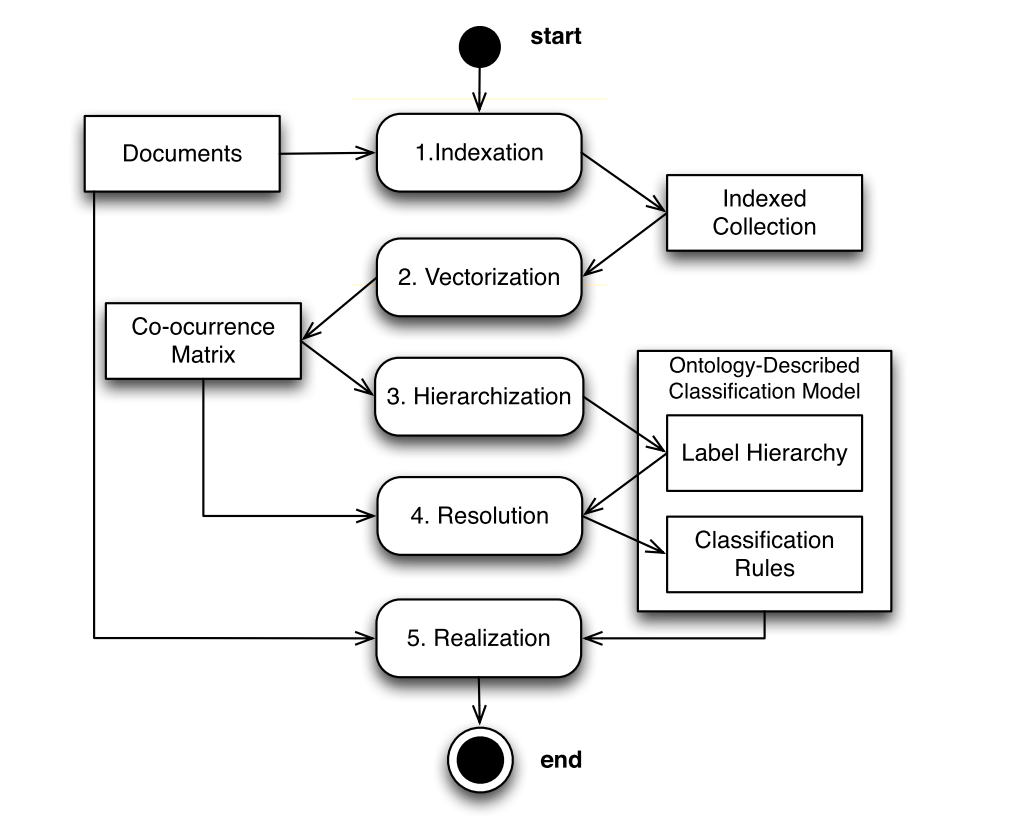
- Indexation extracts terms from data items and creates an index of data items.
- Vectorization calculates the term-frequency vectors of the indexed items.
- Hierarchization creates the label taxonomy (i.e. subsumption hierarchy) using term-frequency vectors.
- Resolution describes taxonomy concepts using relevant terms and creates the reasoning rules to classify data items with labels based on term-frequency vectors.
- Realization populates the ontology with items and then determines, for each item, the most specific label and all its subsuming labels.
Adaptive process according to a stream of items
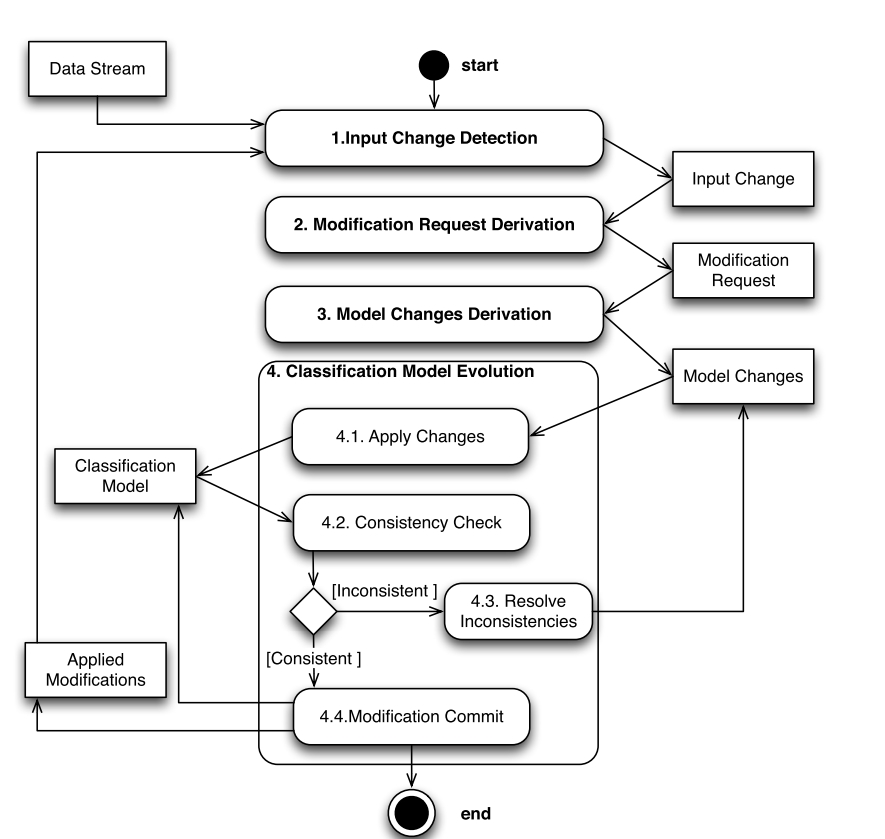
The classification model’s adaptive process is the set of activities necessary to maintain the classification model in accordance with the data stream, but independent of any particularities of the modification and model change types. The process uses a Single-model incremental approach [Hulten et al., 2001, Wang, 2006] where the classification model is incrementally adapted regarding new data.
Publications
- Adaptive learning process for the evolution of ontology-described classification model in big data context, R Peixoto, C Cruz, N Silva, SAI Computing Conference (SAI), 2016, 532-540
- An unsupervised classification process for large datasets using web reasoning R Peixoto, T Hassan, C Cruz, A Bertaux, N Silva, Proceedings of the International Workshop on Semantic Big Data, 9
- Analyse Sémantique du Big Data par Classification Hiérarchique Multi-Label H Thomas, R Peixoto, C Cruz, A Bertaux, N Silva extraction et Gestion des Connaissances
- Extraction de la Valeur des données du Big Data par classification multi-label hiérarchique sémantique T Hassan, R Peixoto, C Cruz, A Bertaux, N Silva, 12ème atelier sur la Fouille de Données Complexes (FDC)
- Hierarchical Multi-Label Classification Using Web Reasoning for Large Datasets, R Peixoto, T Hassan, C Cruz, A Bertaux, N Silva, Open Journal of Semantic Web (OJSW) 3 (1), 1-15, 2016
- Semantic HMC for big data analysis, T Hassan, R Peixoto, C Cruz, A Bertaux, N Silva, Big Data (Big Data), 2014 IEEE International Conference on, 26-28, 2014
- Semantic hmc for business intelligence using cross-referencing R Peixoto, H Thomas, C Cruz, A Bertaux, N Silva, 14th International Conference on Informatics in Economy, 2015
- Semantic HMC: a predictive model using multi-label classification for big data, R Peixoto, T Hassan, C Cruz, A Bertaux, N Silva, Trustcom/BigDataSE/ISPA, 2015 IEEE 2, 173-179,2015
- Semantic HMC: Ontology-Described Hierarchy Maintenance in Big Data Context, R Peixoto, C Cruz, N Silva, OTM Confederated International Conferences" On the Move to Meaningful, 2015
Les partenaires
Pr. Nuno Silva ISEP - Instituto Superior de Engenharia do Porto, Portugal