S-HMC RecSys
A Big Data and Semantic Web approach for mining and automatically classifying web data.
This work was the subject of Thomas Hassan's PhD.
Context
This project follows on from earlier research in David Werner's PhD, in partnership with the company First-Eco, which specialises in recommending economic news. That work defined a process for analysing and classifying textual data based on semantic tools and an inference engine. Preliminary results were published and showed the limits of the approach. This project is also in partnership with First-Eco.
The work
The work is organised around four scientific challenges:
- Unsupervised construction of a predictive model in a Big Data context, for classifying natural language text
- Use and scaling of logical reasoning in a Big Data context, for classification based on a semantic description of information
- Integration of a predictive model for discovering information sources and cross-referencing information on the web
- Adaptation of a predictive model, described by an ontology, to data changes in an unstructured web context
The contributions of this work are threefold.
- First, a data analysis architecture called Semantic HMC, or Hierarchical Multi-label Classification, is described. It extends the work of Werner (2015) and overcomes its technical limitations. The architecture learns a classification model from large volumes of data and uses this model to classify new data. Both aspects are thoroughly evaluated in chapters 3 and 4. The results first show the feasibility of the approach in a Big Data context. The quality of the generated model is assessed through a lexical evaluation for learning a hierarchy of target attributes in an unsupervised setting, and through performance close to the state of the art for the classification task. The lexical evaluation shows the potential of the approach for extracting qualitative attributes and class attributes in an unsupervised setting. The classification evaluation shows results close to the state of the art for multi-label classification in a supervised setting, and suggests good performance in an unsupervised setting, although no comparison with the state of the art was possible. This architecture is the main contribution of the work, since the other two partly rely on it. It was developed in collaboration with Rafael Peixoto, whose contribution to formalising the approach was essential to the development and publications of the project, notably Hassan et al. (2015), Peixoto et al. (2015b), Peixoto et al. (2015c), Peixoto et al. (2016b) and Peixoto et al. (2016c). Chapters 2 to 4 reflect this collaboration, and part of their content is similar to Rafael Peixoto's PhD work.
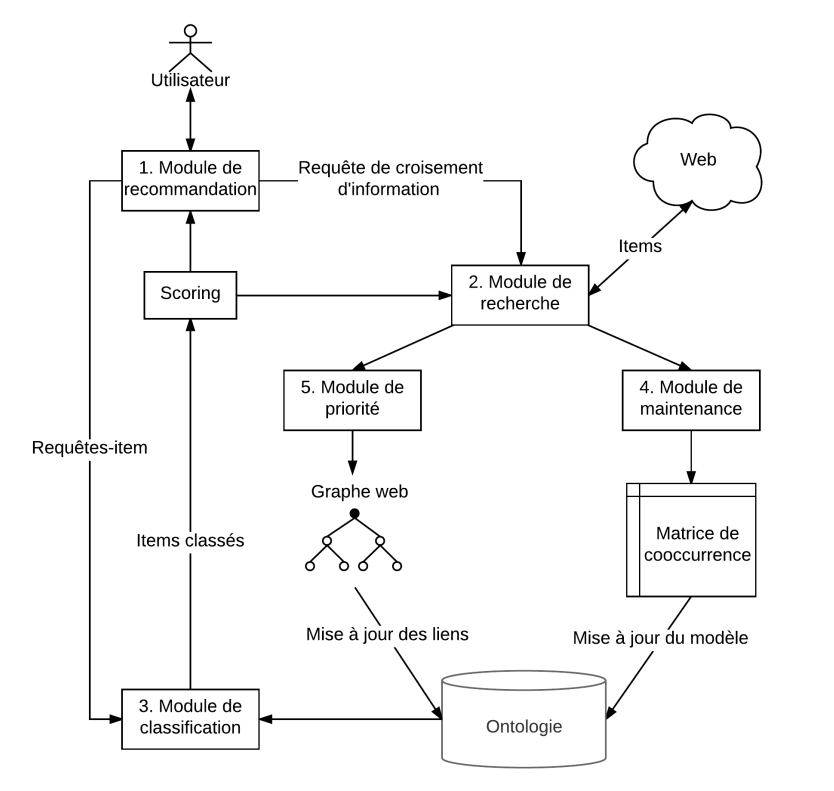
- The second contribution is an architecture for searching and cross-referencing information on the web, based on a semantic qualification of information from the Semantic HMC architecture. This second architecture addresses the scientific challenges of web information retrieval by combining machine learning methods and Semantic Web technologies. It reflects the work presented in Hassan et al. (2017). The architecture is evaluated on the cross-referencing task and compared with a state-of-the-art approach. The evaluation shows the advantages of the approach, which allows continuous adaptation of information retrieval and improves performance over the state of the art.
- The last contribution concerns applying the approach in a real industrial context. This application is one of the original motivations of the work, supported by the company Actualis SARL, a partner and part-funder of this research project. Beyond developing a proof of concept and solving the scientific challenges, real implementation issues were always at the heart of the project. Producing reliable software that adds value in a specific business context is one of the goals of this work. The application addresses concrete issues in the company, notably to improve critical parts of the documentalists' work. The volume of data they process every day is large, which can lead to a loss of information for their customers.
Architecture of the SemXDM solution
Partners
- The company First-Eco
- The SPIM doctoral school and the Burgundy Regional Council, for funding the Young Researcher-Entrepreneur grant
- SATT-GE, for managing the collaboration contract
Publications
Conférences internationales
- Thomas Hassan, Christophe Cruz, Aurélie Bertaux; Predictive and Evolutive Cross-Referencing for Web Textual Sources; SAI Computing Conference 2017 18-20 July 2017 - London, United Kingdom.
- Hassan Thomas, David Werner, Aurélie Bertaux, Christophe Cruz. PROFILE REFINEMENT IN ONTOLOGY-BASED RECOMMANDER SYSTEMS FOR ECONOMICAL E-NEWS.IE, The 14th International Conference on Informatics in Economy, May 2014, Bucharrest, Romania. 2014
- Hassan, T., Peixoto, R., Cruz, C., Bertaux, A., & Silva, N. (2014, October). Semantic HMC for big data analysis. In Big Data (Big Data), 2014 IEEE International Conference on (pp. 26-28). IEEE.
- Hassan, T., Peixoto, R., Cruz, C., Bertaux, A., & Silva, N. Extraction de la Valeur des données du Big Data par classification multi-label hiérarchique sémantique. 12ème atelier sur la Fouille de Données Complexes (FDC) Extraction et Gestion des Connaissances (EGC 2015).
- R. Peixoto, T. Hassan, C. Cruz, A. Bertaux, and N. Silva “Semantic HMC for business intelligence using cross-referencing” in 14th International Conference on Informatics in Economy (IE2015)
- R. Peixoto, T. Hassan, C. Cruz, A. Bertaux, and N. Silva, “Semantic HMC: A Predictive Model using Multi-Label Classification For Big Data,” in the 9th IEEE International Conference on Big Data Science and Engineering (IEEE BigDataSE-15), 2015
- Werner, D., Hassan, T., Bertaux, A., Cruz, C., & Silva, N. (2015). Semantic-Based Recommender System with Human Feeling Relevance Measure. Intelligent Systems in Science and Information 2014 (pp. 177-191). Springer International Publishing.
- Peixoto, R., Hassan, T., Cruz, C., Bertaux, A., & Silva, N. (2016, June). An unsupervised classification process for large datasets using web reasoning. In Proceedings of the International Workshop on Semantic Big Data (p. 9). ACM.
Revues internationales
- Peixoto, R., Hassan, T., Cruz, C., Bertaux, A., & Silva, N. (2016). Hierarchical Multi-Label Classification Using Web Reasoning for Large Datasets. Open Journal of Semantic Web (OJSW), 3(1), 1-15.